
Seed
- Difficulty
-
hard - Rank
- #24
- Flags
-
Sewilam Hakiki NangiaБукасов Сергей Михайлович 7496
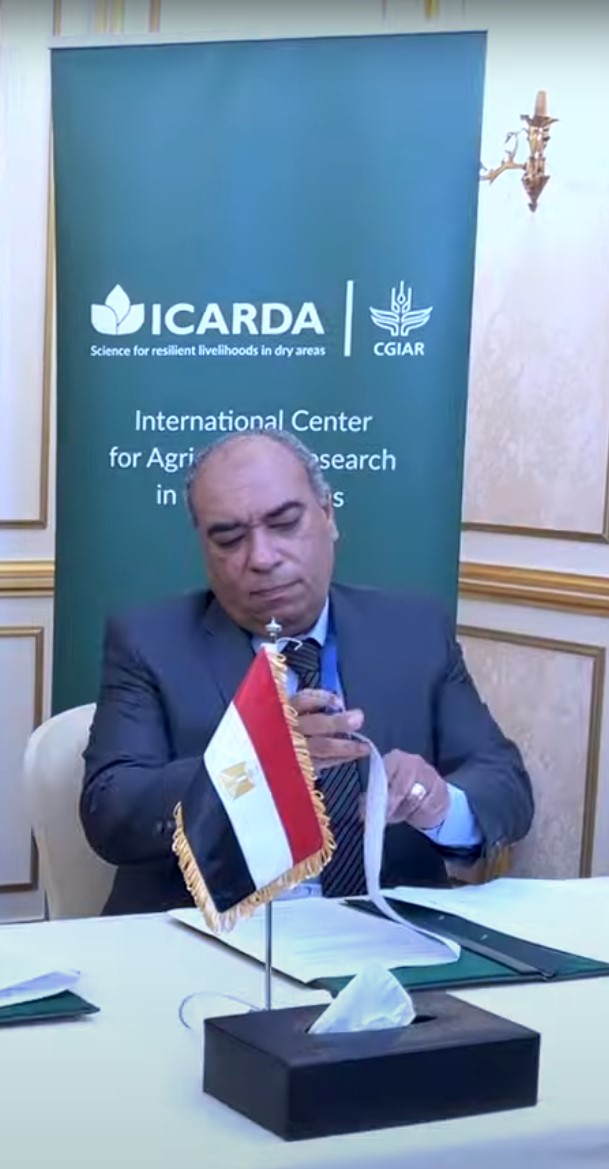
This photo, taken during a ceremony, shows one of the signatories.
Question 1
Question
What are the surnames of the three people who were present?
On the picture, there’s two disctinct signs: “ICARDA” on the wall behind the man, and an Egyptian flag in front of him.
From here, let’s search ICARDA signature egypt to found the ICARDA’s article about an agreement
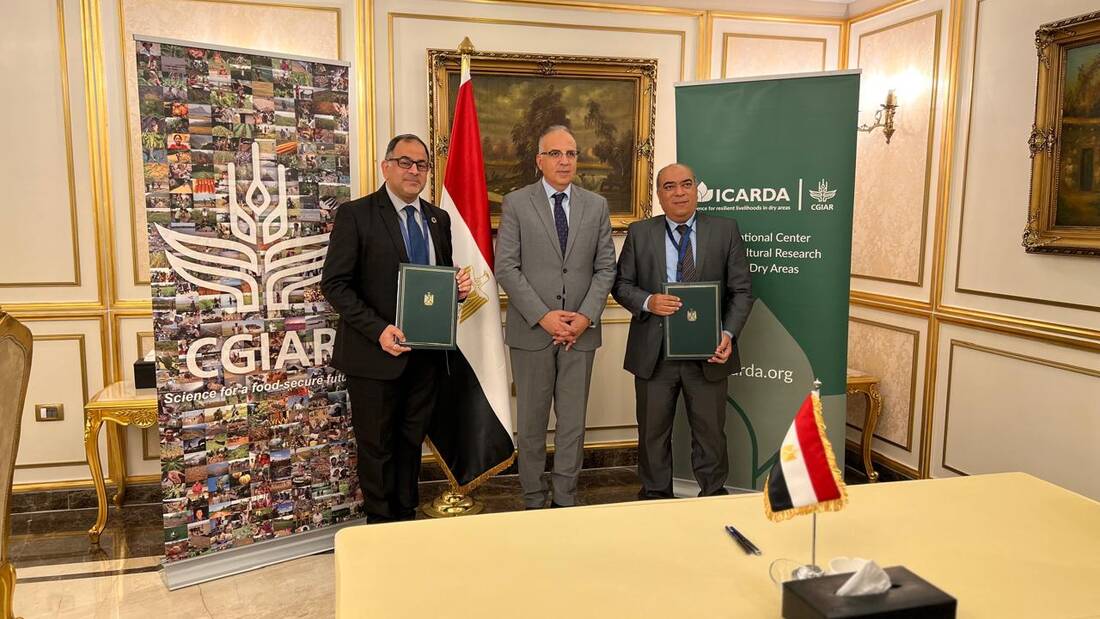
The article contains a larger image of the 3 signatories, allowing us, and their name are in the description under the image!
Answer
Sewilam Hakiki Nangia
That’s it! Really, that simple? That’s just the beginning…
Question 2
Question
The war in Syria forced ICARDA to take an unprecedented measure: while countries such as Burundi, Cameroon or Mali were concerned by only a single « sample », another country accounted for ten.
What is the full name, in the original language, of the person who collected several « samples » from that country? And how many « samples » came from Syria?
By a bit of research, ICARDA is the “International Center for Agricultural Research in the Dry Areas”, that collects seeds from all around the world (and mostly from dry areas), and store them in seed vaults.
By searching ICARDA seed vault, all news are talking about how ICARDA has deposited seeds in the Svalbard Global Seed Vault.
Svalbard is a well known Seed Bank in Norway, that store seeds from all around the world in a very secured location. ICARDA seems to be one of the main contributor.
Now as what happened with Syria, searching seed vault "icarda" "syria" war gives a news article from SeedVault talking about how ICARDA withdrawed a lot of their seeds from Svalbard to Syria because of the war there.
Alright, now we need to somewhat search inside a large database of seed samples to find the country with 10 samples, and how many samples came from Syria.
By searching Svalbard seed search, we can find the Search Portal. Let’s open the “Advanced Search” and fill it as follow:
| Search by | Seed samples | |
| Institute | SYR002:ICARDA | Just searching “ICARDA” and select the one from Syria, not Lebanon |
| Action | Withdrawals | Only withdrawals are concerned, not deposits |
| All other | - All - | |
Once the search is done, hit the “Export button” next to the search button. There’s like 100,000+ results, so we need to script it to find the country with 10 samples.
We could just apply Syria filter on the “Country of collection” to find how many samples came from Syria, but let’s do it all at once with a script.
The given file is in Excel format (.xlsx), but it’ll be easier in CSV. We can open the file with Excel (or LibreOffice) and export it as CSV with ; as separator.
Let’s write a small Python script to count the number of samples per country:
import csvimport jsonfrom collections import defaultdict
countries = defaultdict(int)with open("SeedSamples.csv", "r", encoding="utf-8") as f: reader = csv.reader(f, delimiter=";")
head = next(reader) # Skipping header line icountry = head.index("Country of collection")
for line in reader: # Counting entries per country country = line[icountry] countries[country] += 1
# Sorting result by number of entries per country and print it sorted_countries = dict(sorted(countries.items(), key=lambda x: x[1], reverse=True)) print(json.dumps(sorted_countries, indent=4))The result is something that looks like the following:
{ "Unknown": 17541, "Ethiopia": 11617, "Turkey": 9874, "Syria": 7496, ... "Guatemala": 10, ...}We can clearly read that Syria has 7496 samples, and the country with 10 samples is Guatemala!
Now, we need to find the collector of these samples from Guatemala.
Let’s open back Excel or Search Portal, and filter the “Country of collection” with “Guatemala” to get a view of all 10 samples from Guatemala.
In the meantime, we can Google search ICARDA accession to find the ICARDA GRS Accessions database. This website doesn’t contain any interface, but is indeed an API. Multiple results of our search use the format https://grs.icarda.org/accessions/?IG=XXXX to get information about a specific accession/sample.
We indeed have the “IG” (“Accessssion Number”) code in the Excel file or Search portal from Svalbard! Let’s try them all one by one to find the collector name.
| IG | Link | Collector |
|---|---|---|
| 84032 | Link | - |
| 28380 | Link | - |
| 28534 | Link | - |
| 131936 | Link | S.M. Bukasov |
| 85345 | Link | - |
| 494 | Link | - |
| 131916 | Link | S.M. Bukasov |
| 84913 | Link | - |
| 4410 | Link | S.M. Bukasov |
| 51788 | Link | - |
3 of the results have a named collector, and it’s always the same person: S.M. Bukasov.
Let’s Google search their name to find their full name! We can quickly find a French Wikipedia article about him. He’s a Russian botanist, and his name in his natal language (Cyrillic) is written on the page.
Answer
Букасов Сергей Михайлович 7496
Well done guys, we made it to the end of this Advent Calendar 2025!